Marketing Sherpa recently published Marketing Wisdom for 2006: 110 Marketers and Agencies Share Real-Life Tips, its annual compendium of practical marketing knowledge. As always, the report features a mix of the off-beat and on-target, but provides enough creative and useful ideas to keep marketing practicians busy until next year's report is published.
One item that immediately caught my eye was a paragraph in the introduction by editor Anne Holland: "The more broad the copy was, in a misguided effort to appeal to more people, the less it appealed to anyone...to write great targeted copy, you need a pile of market research to base wording and focus on. And, in trying to get campaigns off the ground quickly, we all sometimes skip that essential step."
I shared that lesson in a company I was doing some work for a while back. They brought me in at the 11th hour on an email campaign for a new product launch. The copy was watered-down mush designed to appeal to the broad array of companies the email would be sent out to, which meant, as Anne points out above, that it didn't really appeal to anyone. It was too late to rework the campaign at that point, so I tweaked the copy as best I could, but the result was predictable: a whopping 0.1% response rate.
For subsequent campaigns, I persuaded the company to target their messages much more precisely. For example, instead of doing a campaign to "computer manufacturers," do separate campaigns for mass market branded manufacturers (e.g. Dell, HP, Gateway), white box makers (e.g. Systemax, Equus), and high-performance specialty producers (e.g. Alienware). Although precisely targeted campaigns are more costly, response rates are also inevitably much higher.
Campaigns do best when they approach one-to-one marketing, at least using micromedia to target micromarkets.
*****
Terms: Marketing Sherpa, marketing wisdom for 2006, micromarkets, micromedia, practical marketing ideas
The Web marketing portal: WebMarketCentral.com
Contact Tom Pick: tomATwebmarketcentral.com
RSS feed
dimanche 14 mai 2006

samedi 6 mai 2006
More on Blogging for Business
George Dixon of the Minneapolis-based virtual marketing agency KC Associates recently put together a concise but helpful summary of the pros and cons of business blogging titled To Blog, or Not to Blog. The conclusion is "yes," despite the fact that, as George points out, "there’s no real business model for turning corporate blogging into a tangible return on investment."
The article points out that business blogs can help build your brand, drive traffic to your Web site, and establish your company as a thought leader. Blogs may show up well in search engines, though I remain unconvinced at this point. (For a quick and easy check of how well your blog shows up on all of the most popular search engines, try a few key key phrases from your blog in this handy search position check tool from Mike's Marketing Tools.)
George also provides a number of sensible recommendations for business blogging success, including having a plan before you start; promoting your blog; establishing metrics; and, most helpfully, "Don’t expect miracles." Blogs can be a productive supplement to other marketing activities, but are not a replacement for PR, newsletters, and other communications.
The VantagePoint article library on the KCA site also contains a number of other practical postings, such as 5 Tips for Selling at Trade Shows, 7 Tips for Online Media Buys, and Top 10 Biggest PR Mistakes.
*****
Terms: virtual marketing agency, business blogging, corporate blogging, blog search position
The Internet marketing strategy portal: WebMarketCentral.com
Contact Tom Pick: tomATwebmarketcentral.com
RSS feed
The article points out that business blogs can help build your brand, drive traffic to your Web site, and establish your company as a thought leader. Blogs may show up well in search engines, though I remain unconvinced at this point. (For a quick and easy check of how well your blog shows up on all of the most popular search engines, try a few key key phrases from your blog in this handy search position check tool from Mike's Marketing Tools.)
George also provides a number of sensible recommendations for business blogging success, including having a plan before you start; promoting your blog; establishing metrics; and, most helpfully, "Don’t expect miracles." Blogs can be a productive supplement to other marketing activities, but are not a replacement for PR, newsletters, and other communications.
The VantagePoint article library on the KCA site also contains a number of other practical postings, such as 5 Tips for Selling at Trade Shows, 7 Tips for Online Media Buys, and Top 10 Biggest PR Mistakes.
*****
Terms: virtual marketing agency, business blogging, corporate blogging, blog search position
The Internet marketing strategy portal: WebMarketCentral.com
Contact Tom Pick: tomATwebmarketcentral.com
RSS feed
lundi 1 mai 2006
Forrester on Blogging
Charlene Li at Forrester Research has put together a nice report on how businesses can effectively utilize blogging (free, but registration is required for non-clients), titled "Blogging: Bubble or Big Deal?." The report describes the growing popularity of blogs; why companies should consider blogging; how companies can take advantage of blogs; and best practices in corporate blogging.
A few of Charlene's key findings:
- Although overall blog readership is still a small percentage of the total population, blog readers and bloggers themselves are highly influential.
- "Blogs...entered the common mainstream this summer during the political conventions." While there's no reason to doubt the accuracy of Forrester's consumer research, this statement is somwhat misleading. Blogs have been highly popular and widely read within specific communities (for example, IT, marketing, and politics) for considerably longer.
- Companies, particularly public companies, should, at a minimum, monitor what is being said about them on blogs. This seems like obvious advice -- companies should monitor their coverage across all media -- but it is commonly ignored.
- Companies can't stop their employees from blogging, but they can and should provide guidelines as to what is appropriate and permissible. That certainly makes sense; one could say the same things about Web surfing or company email usage.
- Internal blogs are a great way to keep project teams informed.
- "Companies that present a human face have an advantage." Blogs are informal conversations with customers. Companies that are comfortable with such conversations should find success with blogs. Companies that aren't comfortable with such conversations won't have customers for long, regardless.
Charlene also writes her own blog.
If your company is wondering how blogs fit into an overall communications strategy, this report is a great place to start, along with Why Write a Blog for Business? on WebMarketCentral.
*****
Terms: Charlene Li, business blogging, business blog strategy
Web marketing resources and news: WebMarketCentral.com
Contact Tom Pick: tomATwebmarketcentral.com
RSS feed
A few of Charlene's key findings:
- Although overall blog readership is still a small percentage of the total population, blog readers and bloggers themselves are highly influential.
- "Blogs...entered the common mainstream this summer during the political conventions." While there's no reason to doubt the accuracy of Forrester's consumer research, this statement is somwhat misleading. Blogs have been highly popular and widely read within specific communities (for example, IT, marketing, and politics) for considerably longer.
- Companies, particularly public companies, should, at a minimum, monitor what is being said about them on blogs. This seems like obvious advice -- companies should monitor their coverage across all media -- but it is commonly ignored.
- Companies can't stop their employees from blogging, but they can and should provide guidelines as to what is appropriate and permissible. That certainly makes sense; one could say the same things about Web surfing or company email usage.
- Internal blogs are a great way to keep project teams informed.
- "Companies that present a human face have an advantage." Blogs are informal conversations with customers. Companies that are comfortable with such conversations should find success with blogs. Companies that aren't comfortable with such conversations won't have customers for long, regardless.
Charlene also writes her own blog.
If your company is wondering how blogs fit into an overall communications strategy, this report is a great place to start, along with Why Write a Blog for Business? on WebMarketCentral.
*****
Terms: Charlene Li, business blogging, business blog strategy
Web marketing resources and news: WebMarketCentral.com
Contact Tom Pick: tomATwebmarketcentral.com
RSS feed
samedi 22 avril 2006
Furl Gives Backflip Real Competition
I've previously posted about Backflip, an online service that enables you to bookmark Web pages, search them, and share them selectively. Backflip is great for research, as it allows you to categorize saved pages in folders or subfolders, add comments, and share them publicly, with only a select group of individuals (by email), or keep them private.
However, a new service called Furl has added some features that Backflip has always, annoyingly, been missing. Unfortunately, Furl isn't quite everything that Backflip is plus more, so the ultimate answer as to which service is better remains "it depends." But Furl does have several key advantages.
Commenting: Both Backflip and Furl allow you to add comments for a saved page, but Furl also lets you rate each page from 1-5 and add keywords (very helpful for searching) as well as prose comments.
Searching: Again, both Backflip and Furl allow you to search your saved pages, but Furl provides greater flexibility for search filtering, such as searching only pages saved within a specific folder.
Multi-browser support: Backflip works only with Internet Explorer. Furl works better and has more functionality with IE, but will work sufficiently well with Firefox. (I wasn't able to add Furl to the toolbar in Firefox after several attempts, but pages can be Furled by right-clicking on them.)
Backflip still has the advantage in a couple of other areas.
Folder nesting: Furl lets you create only one flat level of folders. Backflip allows folders within folders, for finer categorization.
Group research: One of the most powerful features of Backflip has always been its group functionality. When you set up a group within Backflip, any member of the group can add pages to a folder, and all members are notified automatically be email whenever a new page is added by another member. Furl doesn't appear to offer anything like this.
Overall, Furl wins based on commenting and search functionality, and its the only choice for Firefox users. For group research work, however, Backflip remains a better choice.
*****
Terms: Web research tools, Backflip, Furl, Web page archiving, online bookmarking tools
Web marketing news and resources: WebMarketCentral.com
Contact Tom Pick: tomATwebmarketcentral.com
RSS feed
However, a new service called Furl has added some features that Backflip has always, annoyingly, been missing. Unfortunately, Furl isn't quite everything that Backflip is plus more, so the ultimate answer as to which service is better remains "it depends." But Furl does have several key advantages.
Commenting: Both Backflip and Furl allow you to add comments for a saved page, but Furl also lets you rate each page from 1-5 and add keywords (very helpful for searching) as well as prose comments.
Searching: Again, both Backflip and Furl allow you to search your saved pages, but Furl provides greater flexibility for search filtering, such as searching only pages saved within a specific folder.
Multi-browser support: Backflip works only with Internet Explorer. Furl works better and has more functionality with IE, but will work sufficiently well with Firefox. (I wasn't able to add Furl to the toolbar in Firefox after several attempts, but pages can be Furled by right-clicking on them.)
Backflip still has the advantage in a couple of other areas.
Folder nesting: Furl lets you create only one flat level of folders. Backflip allows folders within folders, for finer categorization.
Group research: One of the most powerful features of Backflip has always been its group functionality. When you set up a group within Backflip, any member of the group can add pages to a folder, and all members are notified automatically be email whenever a new page is added by another member. Furl doesn't appear to offer anything like this.
Overall, Furl wins based on commenting and search functionality, and its the only choice for Firefox users. For group research work, however, Backflip remains a better choice.
*****
Terms: Web research tools, Backflip, Furl, Web page archiving, online bookmarking tools
Web marketing news and resources: WebMarketCentral.com
Contact Tom Pick: tomATwebmarketcentral.com
RSS feed
lundi 17 avril 2006
Further Expansion at the Web Marketing Portal
Expansion continues at WebMarketCentral with the addition of a new Web marketing resources page for b2b lead generation, a new Web marketing tools page, additional listings for SEO services and ad agencies, and a bigger Web marketing books page.
The new lead generation services page highlights firms that provide teleprospecting, lead management, lead nurturing, appointment setting, lead qualification, and response management services for both b2b and b2c clients.
The Web marketing software tools page offers search engine optimization, e-commerce, Web site development, and Flash generation applications.
The search engine optimization and marketing page has been expanded and continues to get more worldy with several new listings including Fathom SEO in the U.S. (Ohio), Neutralize in the U.K., and RankUno in India.
Finally, WebMarketCentral's directory of marketing, creative, and advertising agencies has several new listings including Wellesley Hills Group, a Boston firm specializing in professional services marketing; KC Associates in Minneapolis (Kirsten Chapman rocks); and Sight Creative in St. Paul (Mark Galloway is putting a fascinating spin on one-to-one marketing; more about that another time).
And as always, the Web marketing news and e-commerce news pages are a convenient place to keep up with what's happening in the industry.
*****
Terms: professional services marketing, Web marketing software tools, top marketing books, creative agencies, marketing agencies, b2b lead generation services
The Web marketing and promotion portal: WebMarketCentral.com
Contact Tom Pick: tomATwebmarketcentral.com
RSS feed
The new lead generation services page highlights firms that provide teleprospecting, lead management, lead nurturing, appointment setting, lead qualification, and response management services for both b2b and b2c clients.
The Web marketing software tools page offers search engine optimization, e-commerce, Web site development, and Flash generation applications.
The search engine optimization and marketing page has been expanded and continues to get more worldy with several new listings including Fathom SEO in the U.S. (Ohio), Neutralize in the U.K., and RankUno in India.
Finally, WebMarketCentral's directory of marketing, creative, and advertising agencies has several new listings including Wellesley Hills Group, a Boston firm specializing in professional services marketing; KC Associates in Minneapolis (Kirsten Chapman rocks); and Sight Creative in St. Paul (Mark Galloway is putting a fascinating spin on one-to-one marketing; more about that another time).
And as always, the Web marketing news and e-commerce news pages are a convenient place to keep up with what's happening in the industry.
*****
Terms: professional services marketing, Web marketing software tools, top marketing books, creative agencies, marketing agencies, b2b lead generation services
The Web marketing and promotion portal: WebMarketCentral.com
Contact Tom Pick: tomATwebmarketcentral.com
RSS feed
samedi 1 avril 2006
WMC Interviews: Mike Schultz

This week, I caught up with Mike Schultz, Publisher of RainToday.com, and co-founder of the Wellesley Hills Group. His organization helps professional services firms, such as law firms and accountants, market their services more effectively. In addition to direct consulting, the firm conducts primary research on best practices in marketing and selling professional services.
WebMarketCentral (WMC): What did you do before RainToday.com?
Mike Schultz (MS): First, RainToday.com is a division of the Wellesley Hills Group, of which I am a founder and principal. Before that I was a Director with Linkage, Inc., a leadership development organizational development consulting firm, running a large P&L there.
WMC: How, when and why did you get started in this business?
MS: John Doerr and I founded the Wellesley Hills Group when we saw the need for professional leadership, marketing, and business development at services firms. Many services firms (accounting, consulting, law, IT services, etc.) are started by professionals who are experts in their fields, but not necessarily about running and growing a business. Many of them want to focus on their area of expertise. They realize that topics like business development, lead generation, branding, etc. are important to their firms, and they need experts and services in these areas to be successful.
We started RainToday.com because there was no outlet for easily accessible, top quality content and intellectual capital in the areas of marketing and selling professional services. Now there is, and we have 32,000 people who receive Rainmaker Report – our free weekly newsletter – every week.
Plus, at the Wellesley Hills Group we have been producing primary research in the areas of marketing and selling professional services, and having RainToday.com allows us to share that research with the broadest audience possible. It helps them because the get the best information available, and it helps us because it positions us as the market leaders in the area because we are leading the thinking and the field research.
WMC: Who is your ideal or typical client?
MS: Our typical client is in one of two areas:
1. A small to mid-sized professional services firm ($5 to $100 million in revenue) that needs help with strategy (i.e. what should we do to grow this firm), marketing and lead generation (i.e. what should we do to create new conversations, communicate our value, and improve our brand), and business development (i.e. we have all these people who should be selling more…how do we make that happen?)
2. Large service businesses ($100m to multi-billion) that need expert consulting in service business marketing and leadership. Even as a niche firm, we serve these large businesses because of our global research capabilities and because while a big 4 accounting firm might be a multi-billion dollar businesses, they still operate in “practices” that are, usually, much like our “profile #1” client above.
WMC: What sets you apart from your competition?
MS: We’re very good at helping service firms to grow their revenue. We focus all of our attention at our firm – services, staff, research – on this topic.
I'm sure there are other firms out there that might be good at this, but frankly, we don't spend a lot of time thinking about that. In the end, we do what we say we’re going to do for our clients; we do it reliably, and we do it well.
WMC: How do you market and promote your business?
MS: Relentlessly (as we suggest our clients should do). Here are just a few things going on at RainToday.com and the Wellesley Hills Group.
Besides doing a great job for our clients every day, and getting repeat business and referrals, we do:
Wellesley Hills Group:
* 30 speaking engagements per year
* 6 breakfast seminars run by us
* 12 public seminars (one- and two-day) run by us
* Partnerships with leading industry associations
* Over 10,000 people on our newsletter list, where we share original articles and research results
* Tens of thousands of pieces of direct mail.
* Direct telephone calling to clients and prospects.
* Publish original research and articles every quarter.
* Get PR in major magazines (e.g. 2 hours before doing this interview with you, I saw that I was quoted as an expert in Business Week)
* Search Engine Optimization – we have a number of very strong top 10 results in Google
* RainToday.com – 32,000 people reading our work every week and seeing us as experts
* More…
RainToday.com
* PR based on research reports
* Partnerships and affiliates online with associations and other industry leaders
* Search engine optimization
* Search engine marketing
* More…
WMC: What's the biggest or most important marketing lesson you've learned since you founded RainToday and the Wellesley Hills Group?
MS: Long term passion, energy, and enthusiasm are necessary, but not sufficient, for marketing and sales success at services firms. You need to have the right strategy, with the right tactics, with the right budget, in the right timeframes, to have success. And, especially in service businesses, you need strong leadership to make sure all the principals, partners, consultants, and professionals work with marketing and sales to allow them to succeed.
*****
Terms: professional services marketing, marketing and selling professional services, service business development, professional services research
The Web marketing and promotion portal: WebMarketCentral.com
Contact Tom Pick: tomATwebmarketcentral.com
RSS feed
dimanche 19 mars 2006
Micromarkets Part 2
A few weeks back, I wrote about the dichotomy of micromarkets and mass markets. On a recommendation from Tom Austin , I just read The Rule of Three -- a book which nicely ties together my musings on how small, focused companies can thrive in the shadow of industry giants.
The Rule of Three, by Jagdish Sheth and Rajendra Sisodia, posits that over time, every industry comes to be dominated by three large generalists, with any number of small niche players also thriving. Examples abound: in athletic shoes, it's Nike, Adidas, and Reebock coexisting with specialists such as Saucony. In airlines, it's United, American, and Delta, with focused niche players like Southwest.
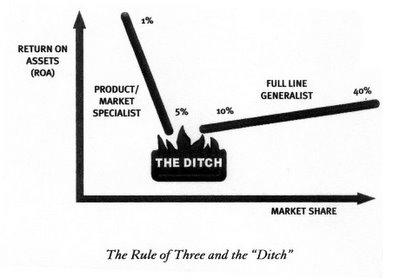
Niche specialists thrive by earning high margins serving a small percentage of the overall market. Generalists focus on efficiently addressing the needs of a large share of the market. Niche companies that try to grow too fast, and generalists who fail to achieve critical mass, are in danger of falling into the dreaded "ditch," as illustrated below. Their market share is too small to enable them to compete effectively against the giants, while their product and market focus is too broad to enable them to compete against the niche players. Northwest Airlines, which is currently flirting with bankruptcy, and K-Mart are examples of ditch companies.
Markets are dynamic, of course, and the makeup of the big three can change over time -- and sometimes in a very short span of time. For example, IBM, the undisputed leader in PC manufacturing in the 1980s, is no longer even much of a niche player in the space. Niche players can become market leaders (though the path is fraught with peril), smaller generalists can leapfrog leaders with new technology, or smaller generalists can combine through mergers and acquisitions to emerge as big-three companies.
The Rule of Three also provides a wealth of strategic advice for companies in each market position. Market-focused niche players will be most successful by developing new products for their tightly-defined market. Product-focused niche companies succeed by finding new markets for existing products (the ever-expanding number of uses for baking soda is a classic example).
Market leaders are advised to be fast followers rather than innovators. For example, Microsoft is the leading provider of word processing, presentation, and spreadsheet applications -- although it didn't invent any of them. The third-largest company in any industry normally is -- and needs to be -- the most innovative. For example, Chrysler brought back the convertible and developed the minivan.
The structure applies to b2b companies as well as b2c firms. In the business software market, Gelco Expense Management is a classic product nicher; it has one narrow product (online expense reporting) that suits multiple industries. SoftBrands is a market niche company -- it sells a broad suite of software and services to a narrow slice of the manufacturing market: midsized companies that produce assembled products. The company's strategy may appear confused because it also sells software to the hospitality industry. However, as The Rule of Three points out, niche companies can successfully compete in more than one niche -- as long as operations remain separate and focused. The danger for niche companies is the temptation to grow by becoming generalists. If SoftBrands tried to compete head-to-head in business software applications with SAP, Oracle, or Microsoft, it would find itself pulled into the ditch.
The Rule of Three does an excellent job both of explaining industry structures -- how micromarkets and mass-markets co-exist -- and of providing strategy advice to companies large or small who want to thrive and avoid being pushed or pulled into the ditch.
*****
Terms: The Rule of Three, micromarkets, niche marketing, business strategy, strategic focus
The Web marketing portal: WebMarketCentral.com
Contact Tom Pick: tomATwebmarketcentral.com
RSS feed
, I just read The Rule of Three -- a book which nicely ties together my musings on how small, focused companies can thrive in the shadow of industry giants.The Rule of Three, by Jagdish Sheth and Rajendra Sisodia, posits that over time, every industry comes to be dominated by three large generalists, with any number of small niche players also thriving. Examples abound: in athletic shoes, it's Nike, Adidas, and Reebock coexisting with specialists such as Saucony. In airlines, it's United, American, and Delta, with focused niche players like Southwest.
Niche specialists thrive by earning high margins serving a small percentage of the overall market. Generalists focus on efficiently addressing the needs of a large share of the market. Niche companies that try to grow too fast, and generalists who fail to achieve critical mass, are in danger of falling into the dreaded "ditch," as illustrated below. Their market share is too small to enable them to compete effectively against the giants, while their product and market focus is too broad to enable them to compete against the niche players. Northwest Airlines, which is currently flirting with bankruptcy, and K-Mart are examples of ditch companies.

Markets are dynamic, of course, and the makeup of the big three can change over time -- and sometimes in a very short span of time. For example, IBM, the undisputed leader in PC manufacturing in the 1980s, is no longer even much of a niche player in the space. Niche players can become market leaders (though the path is fraught with peril), smaller generalists can leapfrog leaders with new technology, or smaller generalists can combine through mergers and acquisitions to emerge as big-three companies.
The Rule of Three also provides a wealth of strategic advice for companies in each market position. Market-focused niche players will be most successful by developing new products for their tightly-defined market. Product-focused niche companies succeed by finding new markets for existing products (the ever-expanding number of uses for baking soda is a classic example).
Market leaders are advised to be fast followers rather than innovators. For example, Microsoft is the leading provider of word processing, presentation, and spreadsheet applications -- although it didn't invent any of them. The third-largest company in any industry normally is -- and needs to be -- the most innovative. For example, Chrysler brought back the convertible and developed the minivan.
The structure applies to b2b companies as well as b2c firms. In the business software market, Gelco Expense Management is a classic product nicher; it has one narrow product (online expense reporting) that suits multiple industries. SoftBrands is a market niche company -- it sells a broad suite of software and services to a narrow slice of the manufacturing market: midsized companies that produce assembled products. The company's strategy may appear confused because it also sells software to the hospitality industry. However, as The Rule of Three points out, niche companies can successfully compete in more than one niche -- as long as operations remain separate and focused. The danger for niche companies is the temptation to grow by becoming generalists. If SoftBrands tried to compete head-to-head in business software applications with SAP, Oracle, or Microsoft, it would find itself pulled into the ditch.
The Rule of Three does an excellent job both of explaining industry structures -- how micromarkets and mass-markets co-exist -- and of providing strategy advice to companies large or small who want to thrive and avoid being pushed or pulled into the ditch.
*****
Terms: The Rule of Three, micromarkets, niche marketing, business strategy, strategic focus
The Web marketing portal: WebMarketCentral.com
Contact Tom Pick: tomATwebmarketcentral.com
RSS feed
Inscription à :
Articles (Atom)