Many companies, particularly smaller firms, struggle to properly define their target micromarket properly. The natural temptation is to spread efforts widely so as not to miss any possible prospects. For example, one company I worked with said it "focused" on eight (!) vertical markets. You can focus on one, two, possibly even three things simultaneously -- but not eight. The practical result of a "scattershot" approach is that the best prospects are inadequately communicated to, resulting in wasted marketing efforts and dollars, a mushy message, and an inordinately difficult sales process.
By carefully defining and focusing efforts on a micromarket and using the proper micromedia to reach it, companies not only reduce wasted marketing spending but can also finely tune their messages to have the greatest impact on their target market, as opposed to producing lowest-common-denominator prose designed to appeal to a wide variety of prospects, and thereby being of little interest to any.
So how do you define a micromarket? In a word: precisely. For example, "healthcare" is not a market; it's a segment word used by economists, as in "the U.S. spends 14% of GDP on healthcare." The healthcare segment is comprised of several vertical markets, including manufacturing (medical devices, durable medical equipment, pharmaceuticals), financial institutions (insurance companies, banks), providers (hospitals and clinics), professionals (physicians, nurses, medical technicians) and others.
Healthcare is a segment; hospitals and doctors are vertical markets; neonatologists at hospitals with at least 500 beds are a micromarket. By carefully defining and then focusing on a specific micromarket in this way, companies are able to maximize the impact of both marketing dollars and target-specific messaging. The opportunities missed by focusing in this manner are generally those with the most difficult sales cycles and lowest probability of closing -- hardly a big loss.
Once a company has successfully established a beachhead in one micromarket, it can repeat the exercise with others. That creates a path to growth through focused efforts that provide a much higher ROI than a scattershot approach.
*****
Terms: micromarket, micromedia, targeted marketing, marketing focus
The Internet website marketing portal: WebMarketCentral.com
Contact Tom Pick: tomATwebmarketcentral.com
mercredi 20 décembre 2006

mercredi 13 décembre 2006
Adding Social Networking Links to Your Blog
Happening across Blogs Are Like Pliers on the One by One Media blog, I noticed two things: 1) these guys are pretty smart, and 2) the social networking links across the bottom of each post are cool. Where did they get them?

It didn't take long to find the Social Bookmark Link Creator. This handy tool enables you to add links to a variety of social bookmarking sites to each of your blog posts in Blogger, Wordpress, or MoveableType.
I'm guessing it works best with Wordpress. In Blogger, the tool only allows you to add text links to social bookmarking sites, and even then, it took some experimentation to get the links to show up in the right place without breaking my template. It also only provides instructions for creating a vertical list; if you prefer a horizontal list -- which I think looks better -- you'll need to add " " between the links to keep them from running together.
I tried adding social bookmark icons from the ExplodingBoy blog, but couldn't get them to line up properly. At ExplodingBoy, Christopher Ware also provides social bookmark tagging code, though to a more limited number of sites than the One to One folks, and his code only works with PHP pages.
Still, this is, theoretically, a helpful traffic-building tool to add to your blog. Making it easy for readers to tag their favorite posts in your blog for others should bring you more readers, and it's very Web 2.0-ish.
*****
Terms: One by One Media blog, social tagging, social bookmarking, social networking, ExplodingBoy blog, Christopher Ware, blogging tools
The Internet marketing business portal: WebMarketCentral.com
Contact Tom Pick: tomATwebmarketcentral.com

It didn't take long to find the Social Bookmark Link Creator. This handy tool enables you to add links to a variety of social bookmarking sites to each of your blog posts in Blogger, Wordpress, or MoveableType.
I'm guessing it works best with Wordpress. In Blogger, the tool only allows you to add text links to social bookmarking sites, and even then, it took some experimentation to get the links to show up in the right place without breaking my template. It also only provides instructions for creating a vertical list; if you prefer a horizontal list -- which I think looks better -- you'll need to add " " between the links to keep them from running together.
I tried adding social bookmark icons from the ExplodingBoy blog, but couldn't get them to line up properly. At ExplodingBoy, Christopher Ware also provides social bookmark tagging code, though to a more limited number of sites than the One to One folks, and his code only works with PHP pages.
Still, this is, theoretically, a helpful traffic-building tool to add to your blog. Making it easy for readers to tag their favorite posts in your blog for others should bring you more readers, and it's very Web 2.0-ish.
*****
Terms: One by One Media blog, social tagging, social bookmarking, social networking, ExplodingBoy blog, Christopher Ware, blogging tools
The Internet marketing business portal: WebMarketCentral.com
Contact Tom Pick: tomATwebmarketcentral.com
mercredi 6 décembre 2006
Marketing in Reverse: Handling Returns
Marketers promote products, and sales professionals sell them. Understandably, both groups focus on a one-way flow of products -- out the door and into the hands of customers. Little thought is given to the messy problem of products coming back in the door through returns; that's an operations problem. But while marketing generally isn't, and shouldn't be, in charge of the reverse logistics process, it definitely needs to be involved.
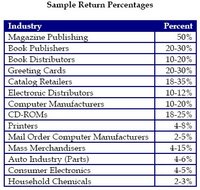
First, returns are a big issue. According to Forbes, "up to 7% of an enterprise’s gross sales are captured by return costs," amounting to a staggering $100 billion per year in the U.S. alone. Return rates vary by product and type of retailer/distributor, from about 5% in consumer electronics, to 15% on average for computer manufacturers, and up to 30% for book publishers.
Second, proper returns handling is important to marketers. As Multichannel Merchant magazine points out in this article, "handling merchandise returns is an important customer touchpoint. Customers who have positive return experiences are the most loyal buyers, as they'll reorder confident that any potential challenges will quickly be resolved."
Your organization may choose to manage the returns process internally using software from a vendor such as Manhattan Associates, ClearOrbit or Sterling Commerce, or outsource the function to a reverse logisitics specialist. Firms offering reverse logistics outsourcing services range from third-party logistics providers like Roadway and UPS to supply chain management outsourcers such as Zomax, Arvato or Inoveris.
If your organization needs help determining the best approach to handling returns management, you may want the services of a consulting firm that understands both operations and marketing, such as Kelly Allan Associates.
But whether done internally or externally, proper returns management is critical both to improving profitability and retaining customers. Sometimes it pays to think backwards.
*****
Terms: reverse logistics management, RMA, returns handing, return rates by industry, ClearOrbit
The Internet marketing advertising portal: WebMarketCentral.com
Contact Tom Pick: tomATwebmarketcentral.com
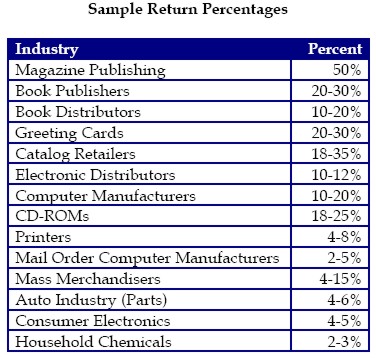
First, returns are a big issue. According to Forbes, "up to 7% of an enterprise’s gross sales are captured by return costs," amounting to a staggering $100 billion per year in the U.S. alone. Return rates vary by product and type of retailer/distributor, from about 5% in consumer electronics, to 15% on average for computer manufacturers, and up to 30% for book publishers.
Second, proper returns handling is important to marketers. As Multichannel Merchant magazine points out in this article, "handling merchandise returns is an important customer touchpoint. Customers who have positive return experiences are the most loyal buyers, as they'll reorder confident that any potential challenges will quickly be resolved."
Your organization may choose to manage the returns process internally using software from a vendor such as Manhattan Associates, ClearOrbit or Sterling Commerce, or outsource the function to a reverse logisitics specialist. Firms offering reverse logistics outsourcing services range from third-party logistics providers like Roadway and UPS to supply chain management outsourcers such as Zomax, Arvato or Inoveris.
If your organization needs help determining the best approach to handling returns management, you may want the services of a consulting firm that understands both operations and marketing, such as Kelly Allan Associates.
But whether done internally or externally, proper returns management is critical both to improving profitability and retaining customers. Sometimes it pays to think backwards.
*****
Terms: reverse logistics management, RMA, returns handing, return rates by industry, ClearOrbit
The Internet marketing advertising portal: WebMarketCentral.com
Contact Tom Pick: tomATwebmarketcentral.com
jeudi 30 novembre 2006
Business Blogs: PR Tool or Marketing Tool?
While working on a PR and marketing plan recently, the question came up: are blogs more of a PR tool or a marketing medium? Seems like an interesting question, yet there has been surprisingly little written about it. "Blog marketing" outscores "blog PR" on a Google search by a margin of about five to two, and you'll find four times as many books about blog marketing at Amazon as you will about blog PR.
However, Online-PR.com (which has a very nice list of blog directories and aggregators, by the way) lists about three times as many blogs devoted to PR as focused on marketing. There's an excellent post about using blogging for PR here from the Top Rank SEO blog, though the marketing vs. PR angle seems a bit confused. InternetNews predicted a couple of years ago that blogging would make corporate PR and marketing obsolete, but clearly that hasn't happened yet.
__________________________________________________________
This post sponsored by Marketing Tools from VerticalResponse
Create professional HTML Email and printed Postcard campaigns in minutes right from your browser. No technical expertise needed - Choose from over 250 templates. It's easy, affordable and powerful. Try it Free Today!
__________________________________________________________
My own conclusion is that blogs are primarily a PR tool. A well-written blog raises awareness and visibility, and establishes credibility -- all of which are PR objectives. Blogs are not particularly strong at direct response; they rarely excel at marketing functions like selling or generating leads directly. Thinking of your blog as a component of your overall PR strategy will help establish the right direction, and the right expectations for results.
*****
Terms: business blogs, blog marketing, blog PR, blogs are a PR tool, online-pr.com, Top Rank SEO blog
The Internet marketing advertising portal: WebMarketCentral.com
Contact Tom Pick: tomATwebmarketcentral.com
However, Online-PR.com (which has a very nice list of blog directories and aggregators, by the way) lists about three times as many blogs devoted to PR as focused on marketing. There's an excellent post about using blogging for PR here from the Top Rank SEO blog, though the marketing vs. PR angle seems a bit confused. InternetNews predicted a couple of years ago that blogging would make corporate PR and marketing obsolete, but clearly that hasn't happened yet.
__________________________________________________________
This post sponsored by Marketing Tools from VerticalResponse
Create professional HTML Email and printed Postcard campaigns in minutes right from your browser. No technical expertise needed - Choose from over 250 templates. It's easy, affordable and powerful. Try it Free Today!
__________________________________________________________
My own conclusion is that blogs are primarily a PR tool. A well-written blog raises awareness and visibility, and establishes credibility -- all of which are PR objectives. Blogs are not particularly strong at direct response; they rarely excel at marketing functions like selling or generating leads directly. Thinking of your blog as a component of your overall PR strategy will help establish the right direction, and the right expectations for results.
*****
Terms: business blogs, blog marketing, blog PR, blogs are a PR tool, online-pr.com, Top Rank SEO blog
The Internet marketing advertising portal: WebMarketCentral.com
Contact Tom Pick: tomATwebmarketcentral.com
vendredi 24 novembre 2006
Got Projects? Try Base Camp
Marketers have projects. So unless you're one of those rare individuals who can not only keep a multitude of details straight in your head, but also magically keep your team on the same page with your brain, you need project management tools. Base Camp is a reasonably-priced (there's even a free version) online project management collaboration tool that's worth checking out, despite a few quirks and shortcomings.
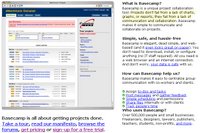
Base Camp, first recommended to me by John Sundberg, president of Kinetic Data, is great for coordinating the efforts of inside people and outside vendors (graphic artists, writers, agencies, web developers, etc.), and is particularly helpful for marketing consultants and contractors who need a practical, affordable project management solution. It offers a useful set of project management features:
- To-do lists with task assignment
- Milestones with date assignment and automatic e-mail notification as due dates approach
- An online document/message creation tool with feedback tracking (great for group editing)
- File-sharing for documents, graphics, Excel files, etc.
- Online time-tracking (with the higher-end paid versions)
- The ability to "brand" your Base Camp login page (making even individual consultants look big-time players)
All of that said, the tool would be much more useful if a few obvious shortcomings were corrected:
- Only the project owner can assign tasks to anyone in the group; other contributors get only a partial list of names in the assignment drop-down
- File sharing is limited to files up to 30MB; it's not unusual to have a graphic file or PowerPoint that exceeds that limit. This size limit should be bumped up considerably.
- Oddly, you can't assign due dates to to-do tasks (you can work around this by including due dates in the task description, but you won't get auto-notification emails)
- Finally, the time tracking option isn't available until you hit the $50/month, 35-project level. It would be nice if this feature were available at a lower, more affordable level, particularly for marketing consultants and contractors who could really use time tracking, but don't need to manage 35 separate projects.
Want to know more? TechCrunch ran a piece on an open-source Base Camp competitor a few months back, but the effort of installing a managing a project management collaboration tool on your own server doesn't seem worth the effort to save Base Camp's modest monthly fee. Alex Dunne also provided a thorough review of Base Camp in September.
If you've got collaborative marketing (or other) projects to manage, Base Camp is worth investigating.
*****
Terms: free online collaborative project management tool, marketing project management collaboration, Base Camp, Alex Dunne blog, TechCrunch
The Internet website marketing portal: WebMarketCentral.com
Contact Tom Pick: tomATwebmarketcentral.com

Base Camp, first recommended to me by John Sundberg, president of Kinetic Data, is great for coordinating the efforts of inside people and outside vendors (graphic artists, writers, agencies, web developers, etc.), and is particularly helpful for marketing consultants and contractors who need a practical, affordable project management solution. It offers a useful set of project management features:
- To-do lists with task assignment
- Milestones with date assignment and automatic e-mail notification as due dates approach
- An online document/message creation tool with feedback tracking (great for group editing)
- File-sharing for documents, graphics, Excel files, etc.
- Online time-tracking (with the higher-end paid versions)
- The ability to "brand" your Base Camp login page (making even individual consultants look big-time players)
All of that said, the tool would be much more useful if a few obvious shortcomings were corrected:
- Only the project owner can assign tasks to anyone in the group; other contributors get only a partial list of names in the assignment drop-down
- File sharing is limited to files up to 30MB; it's not unusual to have a graphic file or PowerPoint that exceeds that limit. This size limit should be bumped up considerably.
- Oddly, you can't assign due dates to to-do tasks (you can work around this by including due dates in the task description, but you won't get auto-notification emails)
- Finally, the time tracking option isn't available until you hit the $50/month, 35-project level. It would be nice if this feature were available at a lower, more affordable level, particularly for marketing consultants and contractors who could really use time tracking, but don't need to manage 35 separate projects.
Want to know more? TechCrunch ran a piece on an open-source Base Camp competitor a few months back, but the effort of installing a managing a project management collaboration tool on your own server doesn't seem worth the effort to save Base Camp's modest monthly fee. Alex Dunne also provided a thorough review of Base Camp in September.
If you've got collaborative marketing (or other) projects to manage, Base Camp is worth investigating.
*****
Terms: free online collaborative project management tool, marketing project management collaboration, Base Camp, Alex Dunne blog, TechCrunch
The Internet website marketing portal: WebMarketCentral.com
Contact Tom Pick: tomATwebmarketcentral.com
jeudi 16 novembre 2006
How to Increase Traffic to Your Website -- Really
Two words -- valuable content. As Mike Kaselnak, CEO of Hoard Client Systems wrote in response to my recent RainToday article How To Build Website Traffic With Content, "The days of trying to trick the search engines are over. Content is King!"
Actually, neither search engines nor people are fooled anymore by tricks with hidden text or metatags. What's more, human visitors expect more from business websites than just product details (marketing), "about us" pages, and a list of your office locations. People want to do business with companies that are smart and helpful, and they expect companies to not only say that on their websites, but prove it by offering content that helps users solve problems, or gives them a one-stop source for information they would otherwise have to scan several sites to retrieve.
What kind of content? Items such as newsfeeds, white papers, blogs, podcasts, reports, book reviews, glossaries, and (truly useful) directories are all generators of relevant website traffic. Such content is not only search engine-friendly, but also attractive and "sticky" to visitors. What's more, demonstrating your industry knowledge and helpfulness not only attracts site visitors but is also helpful in converting them to customers.
The full article with links to resources and related pages is also now available in the Web Marketing Knowledge section of WebMarketCentral as How to Build Site Traffic with Compelling Content. Useful and relevant content can help your site show up better in search engines, attract visitors, and help turn traffic into business.
*****
Terms: build site traffic, increase and grow website traffic, website content, sticky content
The Internet marketing strategy portal: WebMarketCentral.com
Contact Tom Pick: tomATwebmarketcentral.com
Actually, neither search engines nor people are fooled anymore by tricks with hidden text or metatags. What's more, human visitors expect more from business websites than just product details (marketing), "about us" pages, and a list of your office locations. People want to do business with companies that are smart and helpful, and they expect companies to not only say that on their websites, but prove it by offering content that helps users solve problems, or gives them a one-stop source for information they would otherwise have to scan several sites to retrieve.
What kind of content? Items such as newsfeeds, white papers, blogs, podcasts, reports, book reviews, glossaries, and (truly useful) directories are all generators of relevant website traffic. Such content is not only search engine-friendly, but also attractive and "sticky" to visitors. What's more, demonstrating your industry knowledge and helpfulness not only attracts site visitors but is also helpful in converting them to customers.
The full article with links to resources and related pages is also now available in the Web Marketing Knowledge section of WebMarketCentral as How to Build Site Traffic with Compelling Content. Useful and relevant content can help your site show up better in search engines, attract visitors, and help turn traffic into business.
*****
Terms: build site traffic, increase and grow website traffic, website content, sticky content
The Internet marketing strategy portal: WebMarketCentral.com
Contact Tom Pick: tomATwebmarketcentral.com
vendredi 10 novembre 2006
New-media seminar in Minneapolis: Using podcasting and online video to improve your business communications

Curious about what podcasting can do for your business? Check this out. The experts at Twin Cities marketing agency Provident Partners are offering a hands-on presentation and workshop on video and podcasting. This session will save you time and help you understand how new-media formats such as audio podcasts and digital video are being used as powerful tools in the marketing mix.
The seminar will be led by Albert Maruggi, who's been recognized by ClickZ and many other sources for his expertise in new media. He is among the first marketers in the country to actively host a regular podcast, the Marketing Edge, and he advises dozens of organizations on new-media strategies.
The seminar will cover topics such as how podcasting works, how to develop podcast content, how to measure podcasting results, using podcasting in your marketing mix, and the PR opportunities of podcasting.
Details of the seminar:
Thursday, November 30, 2006
10 a.m. to 1 p.m.
790 Cleveland Ave. S., St. Paul, MN
The cost, including lunch, is $100 per person -- but be sure to ask for the WebMarketCentral discount when registering.
To sign up, call 651-695-0174 or email amaruggi@providentpartners.net . Guests should register in advance as space is limited. The registration deadline is November 20 (though you might be able to sneak in later if you mention this blog post).
Also, check out this recent podcast from Albert: The Great Blog Debate. Joined by Mike Keliher of Provident Partners and John Havens of About.com, Albert provides an excellent guide to the possibilities, and risks, of business blogging.
*****
Terms: Provident Partners, St. Paul marketing agency, Minnesota ad agency, podcasting, how podcasting works, Albert Maruggi, Marketing Edge podcast, John Havens, About.com
The Internet marketing advertising portal: WebMarketCentral.com
Contact Tom Pick: tomATwebmarketcentral.com
Inscription à :
Articles (Atom)