samedi 24 juin 2006

Want to generate business? Write a book. (Part 2)


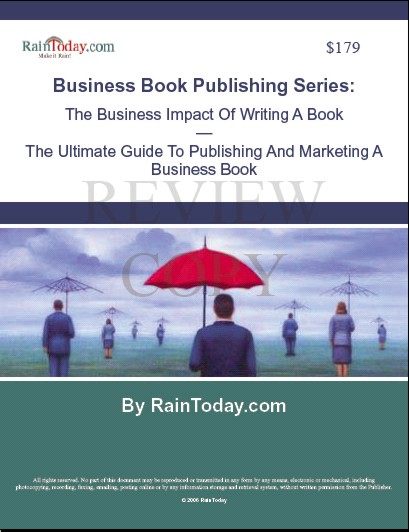
Mike Schultz, a principal at the Wellesley Hills Group, and his team of professional services marketing experts at RainToday.com have released a follow-up report to The Business Impact of Writing a Book, published earlier this year. Their new report, The Ultimate Guide to Publishing and Marketing a Business Book, lives up its name.

The new report not only revisits the research findings presented in their earlier report -- how writing a successful business book positively impacts both business volume and fees -- but provides step-by-step instructions on how to publish and market your book.

Topics covered include:

- How to research and approach literary agents
- How to write a proposal and pitch your book
- Tips to make the writing process easier
- How to market your book (through PR, book tours, speaking opportunities, and the Internet)
- Interviews with a number of publishing professionals

At $180, the report is a bargain if you are serious about writing a business book to promote yourself and your business. This report will pay for itself many times over in the time and aggravation it will save you.

Who knows -- maybe having this report back in 2001 would have saved me from my own ill-fated marketing book adventure (long story).

*****

Terms: search engine optimization tips, SEO help, relevant site links, search engine position improvement, keyword optimization, RainToday.com, Wellesley Hills Group, Mike Schultz

The portal for Internet Web site marketing resources: WebMarketCentral.com

Contact Tom Pick: tomATwebmarketcentral.com

RSS feed
jeudi 22 juin 2006

Time to Vote for Your Favorite Blogs with Marketing Sherpa

Voting is open until midnight tomorrow, Friday June 23rd, for Marketing Sherpa's 2006 Reader's Choice Blog and Podcasting awards. Of the more than 1,000 blogs nominated, the WebMarketCentral blog was among the hundred or so across 11 different categories that made it onto the ballot. I'm not sure whether to be honored by this inclusion, or disturbed that Marketing Sherpa's standards have declined so low. :-)

***UPDATE FROM MARKETING SHERPA:

An Apology from MarketingSherpa: Many of you who've been trying to cast your Vote for Best Blog & Podcast have been bounced off our server. Here's a new link for folks who could not get in:http://www.surveymonkey.com/s.asp?u=803032287919

We're *extending* the deadline to Monday, June 26th, at midnight ET because so many of you could not get in when you wanted to.

***END OF UPDATE

So go vote for your favorite blogs and podcasts! You know what my favorites are. (Just for reference purposes, the WebMarketCentral blog is listed near the bottom of the voting form, one of 30 entries in the "Blogs on general [multiple topic] marketing" category.)

One more note: I had difficulty getting the ballot to appear in Internet Explorer, but it worked like a charm in Firefox.

*****

Terms: Marketing Sherpa Reader's Choice, blog and podcasting awards, best marketing blogs, favorite marketing blogs

The portal for Internet marketing articles: WebMarketCentral.com

Contact Tom Pick: tomATwebmarketcentral.com

RSS feed

samedi 17 juin 2006

Generating Relevant Links

Ralph Wilson at Web Marketing Today recently released his updated Web Marketing Checklist: 32 Ways to Promote Your Website. It's a relatively quick read and may spark some new ideas about site promotion, although most of the search optimization information presented is covered in Search Engine Optimization Basics.

One idea I grabbed from there was improving search engine positioning by exchanging links through the SiteSell Value Exchange. This is a free service that allows you to contact the Webmasters at other sites with content similar to yours and exchange links. It avoids the problems of automated linking solutions that don't generated links from relevant sites and (mostly) avoids spam by providing your site information only to those with related content. Granted, some of the sites included there are somewhat spammy themselves, but you have ultimate control over which links to accept and which to reject.

Another service to consider is MegaWeb Promotion (the site is more professional than the name implies). For $60, they promise targeted traffic. Though skepticism is warranted, for that price it may be worth a try.

Then there is the matter of search engine optimization -- not just sprinkling keywords across the pages of your site, but using the keywords that potential visitors are most often searching for. This is easy if you're doing any paid search advertising, for example, using Google Adwords' keyword generator. Suppose you help companies produce podcasts, as Albert Maruggi at Provident Partners does. Using the Google tool, you could quickly discern that "podcast help," "podcast guide," and "podcast tutorial" are all frequently searched terms. "Podcast FAQ" will generate fewer results, and "podcast tips" is rarely used.

*****

Terms: search engine optimization tips, SEO help, relevant site links, search engine position improvement, keyword optimization

The portal for Internet marketing resources: WebMarketCentral.com

Contact Tom Pick: tomATwebmarketcentral.com

RSS feed

dimanche 11 juin 2006

WMC Interviews: Kirsten Chapman


I recently had the opportunity to talk to Kirsten Chapman, principal of Twin Cities-based virtual marketing and PR agency KC Associates. As KCA's web site notes, this isn't a typical agency; her group works only with b2b technology companies, and is comprised exclusively of senior IT marketing and PR professionals. The result, as Kirsten (front row, checked coat) points out, is that KCA clients pay for talent — not overhead.


WebMarketCentral (WMC): How, when and why did KC Associates get started?


Kirsten Chapman (KC):
KCA got started by accident. Back in the late ‘80s, there were 3-4 of us making a decent living doing contract work and one day the team said “We have a business here and we should really treat it like one.” So, in 1993, we collectively developed a plan to focus exclusively on IT companies (since all of us had good experience in that industry) and now, nearly 15 years later, we have a SWAT team of very talented, super-experienced people who can deliver on nearly any marketing and PR requirement — from strategy and product marketing and marcom, media relations and lead generation.


WMC:
How would you describe KCA's ideal or typical client?


KC:
Small to mid-size IT products and services companies, primarily in the Minneapolis/St. Paul area of Minnesota.


Our group provides both advisory and agency help. Our marketing execs (not account or client execs) come from inside companies and have great empathy for clients’ business objectives and the struggle to achieve them. Those that benefit the most from this are smaller organizations that may or may not have internal marketing staff. If they do, it’s often not an executive, but they know there’s more to marketing than brochures, advertising and websites. They simply don’t know what to do. They need more than an ability to execute, they also need guidance on what to execute and why — something only an experienced biz dev-type marketer can provide.


WMC:

What separates KCA from typical advertising or PR agencies?


KC:
We’re exclusive to IT products and services companies, and we bridge the gaps between sales and marketing, and between strategy and execution, with a full line of integrated marketing and PR services guided by veteran marketing executives. We’re also a virtual firm, so it’s all brain power and results with no overhead.


WMC:
How do you market or promote your business?


KC:
WOM is obviously the top tactic, but we’re also systematic in our outbound lead gen program, which is a service we provide to clients. These two things work together — most companies have heard of KCA, but the lead gen gives us control over reaching out and keeping our name in front of prospects as well as getting introductory meetings. It also shows off how good we are in this area — most agencies don’t know how to do this effectively and don’t have telemarketers on staff. Additionally, we have a monthly e-column, VantagePoint, each written by a different person and we also send out some kind of creative, fun mailer 2x/yr, which updates our database as well as builds brand awareness.


WMC:
What's the biggest or most important marketing lesson you've learned since KCA got started?


KC:
Generating new business is easy; finding the right people to deliver the services is what really counts and it’s where the rubber meets the road. If you want to keep client churn down, make sure you’re always doing the right thing — by them — and find talent who thinks the same way.


WMC:
Anything else you'd like to add?


KC:
KCA is nothing without its great team of extraordinary talent. Make sure you pay people fairly, give them work they like to do and create an environment for them that’s with people they like and respect — co-workers and clients alike. If a client is a pain-in-the-ass and makes life difficult for the team, fire the client.


*****

Terms: b2b technology marketing, virtual marketing agency, IT marketing Twin Cities

The portal for Web marketing strategy development: WebMarketCentral.com

Contact Tom Pick: tomATwebmarketcentral.com

RSS feed

dimanche 4 juin 2006

Salesforce.com's "No Software" Mantra: More Effective Than They Know

From its beginnings, Salesforce.com has emphasized its online delivery model with its "No Software" positioning, even snagging 1-800-NO SOFTWARE as its toll-free line. While the application service provider (ASP) or software-as-a-service (SaaS) model in general has never lived up to its initial hype, among consumers or business users, Salesforce.com has enjoyed impressive success with it.

While the company's success with sales and marketing users is hardly news at this point, I was surprised in doing some research recently at how successful the No Software campaign has been among another group: enterprise software developers. Salesforce.com has apparently succeeded at making "software" a nasty word for many of these firms, almost like a racial slur or a misogynistic anachronism not to be uttered in polite company.

For example, Synopsys, a developer of electronic design automation software, doesn't produce software at all according to either its home page or products page: it makes design products and "platforms." Cerner, a medical software provider, doesn't claim to produce software either, but does display screen shots of its "solutions."

Here are several more examples of software vendors who don't offer (Heaven forbid!) "software," but do provide platforms, solutions, "applications," "services," "environments," "suites," "technologies," "architectures," "engines," "modules," "servers," "tools," or "systems:"

Telcordia (information-networking and operations software)
Hyperion (business intelligence/analytics software)
FileNet (enterprise content management software)
NAVTEQ (digital map data and software)
i2 Technologies (supply chain management software)
Jack Henry & Associates (banking software)
Kronos (time tracking and HR management software)
Per-Se Technologies (medical billing software)
Infor (ERP software)
Eclipsys (clinical software)
Open Text (content management software)
Internet Security Systems (network security software)
DICOM Group (document capture and workflow automation software)

I could go on, but you get the idea. By not only capturing the interest of prospects, but changing the terminology of an entire industry, Salesforce.com has clearly done an outstanding job of branding.

About the only folks who haven't bought into the "No Software" message are industry journalists; all of the companies cited here (including Salesforce.com) appear on the list of the largest 500 software companies compiled by Software Magazine.

*****

Terms: Salesforce.com, no software, application service provider, CRM software, software 500 list, software-as-a-service (SaaS)

The portal for Web site marketing strategy: WebMarketCentral.com

Contact Tom Pick: tomATwebmarketcentral.com

RSS feed

samedi 20 mai 2006

Everybody's Watching...You

This is still a marketing blog, not a political one, but topics where the two areas intersect are fair game. So it is with the recent flap over the NSA searching for suspicious patterns in the phone records of Americans, which is even less shocking than the revelation that professional athletes sometimes chemically enhance their performance.

The fact is, we have very little privacy left, from either the public or private sector. Ever checked your credit report? (You may not want to.) What's in there may surprise you. And it isn't just the big three credit reporting agencies who have this information; almost anyone with a checkbook and a lick of creativity can get the information, including your insurance company.

Got any vices? Alcohol, cigarettes, chocolate almond fudge ice cream? Unless you exclusively pay with cash, your favorite retailer knows exactly what you buy and how often you buy it, and RFID technology will soon provide them with even more information. Once again, if your supermarket clerk knows this, anyone with capital and curiosity can find out.

Do you market a luxury item? Want to know who the wealthiest Americans are? Forget the old Forbes list. You can buy the names, addresses, and phone numbers of the one million most affluent households online. You can even buy lists of consumers based on their health status, hobbies, home value, and buying habits.

The U.S. government has access to all of that data and more. The government, of course, knows where you work, what you do there, where you live, how much money you make, and how many kids you have. You help them update their database every year sometime before April 16th. If you live in a place that has toll roads, the government even knows the route you drive to work and about what time you normally arrive and leave. They also know what's in your backyard (pool, trampoline, hot tub?), how often you use it, and how many people you use it with. (Google's tool limits how closely you can zoom in; the government's view is much closer.)

The government uses its own tools, and partners with the private sector. Ever wonder how the FBI knew so much about the 9/11 terrorists just days after the attack on the World Trade Center -- where they had eaten, rented cars, had lap dances, bought their plane tickets? They got it all from a little Arkansas company called Acxiom. Unfortunately, that little company knows a lot more about you than it does about protecting that information.

But back to the politics: none of this loss of privacy has been caused by George W. Bush. Nor, to be non-partisan, is it Bill Clinton's fault (though it may be partially Al Gore's, since, after all, he invented the Internet).

To anyone with a libertarian bone in their body, this complete lack of privacy is no doubt troubling. Perhaps we need new laws, or perhaps better technology to enable individuals to protect their privacy. But regardless, it is simply ludicrous to assert that government agencies obstensibly tasked with defending our safety and freedom shouldn't have access to the same information as someone wanting to sell us cars or mail out coupons for toothpaste.

*****

Terms: NSA phone records, online privacy, Acxiom, credit reporting, lifestyle data

The Web marketing portal: WebMarketCentral.com

Contact Tom Pick: tomATwebmarketcentral.com

RSS feed

dimanche 14 mai 2006

Marketing Wisdom for 2006

Marketing Sherpa recently published Marketing Wisdom for 2006: 110 Marketers and Agencies Share Real-Life Tips, its annual compendium of practical marketing knowledge. As always, the report features a mix of the off-beat and on-target, but provides enough creative and useful ideas to keep marketing practicians busy until next year's report is published.

One item that immediately caught my eye was a paragraph in the introduction by editor Anne Holland: "The more broad the copy was, in a misguided effort to appeal to more people, the less it appealed to anyone...to write great targeted copy, you need a pile of market research to base wording and focus on. And, in trying to get campaigns off the ground quickly, we all sometimes skip that essential step."

I shared that lesson in a company I was doing some work for a while back. They brought me in at the 11th hour on an email campaign for a new product launch. The copy was watered-down mush designed to appeal to the broad array of companies the email would be sent out to, which meant, as Anne points out above, that it didn't really appeal to anyone. It was too late to rework the campaign at that point, so I tweaked the copy as best I could, but the result was predictable: a whopping 0.1% response rate.

For subsequent campaigns, I persuaded the company to target their messages much more precisely. For example, instead of doing a campaign to "computer manufacturers," do separate campaigns for mass market branded manufacturers (e.g. Dell, HP, Gateway), white box makers (e.g. Systemax, Equus), and high-performance specialty producers (e.g. Alienware). Although precisely targeted campaigns are more costly, response rates are also inevitably much higher.

Campaigns do best when they approach one-to-one marketing, at least using micromedia to target micromarkets.

*****

Terms: Marketing Sherpa, marketing wisdom for 2006, micromarkets, micromedia, practical marketing ideas

The Web marketing portal: WebMarketCentral.com

Contact Tom Pick: tomATwebmarketcentral.com

RSS feed